
 Buyer review
The move count decides the moving method.
A rig that moves once a year and a rig that moves every three weeks are different purchases even when the hoisting duty is identical. The moving method — self-propelled chassis, trailer transport, or an integrated rig moving system — determines the per-move cost, the crew time and the road requirements. The move plan should be written into the equipment decision from the start, because the chassis, the axle configuration and the moving system are all part of the purchase.
The examples use the published figures from the ZYT range: truck-mounted rigs with their transport dimensions, the mobile drilling rigs on self-propelled carriers, and the land rig moving system rated for the skid fleet.
Method 1: Self-propelled moves on a truck-mounted chassis.
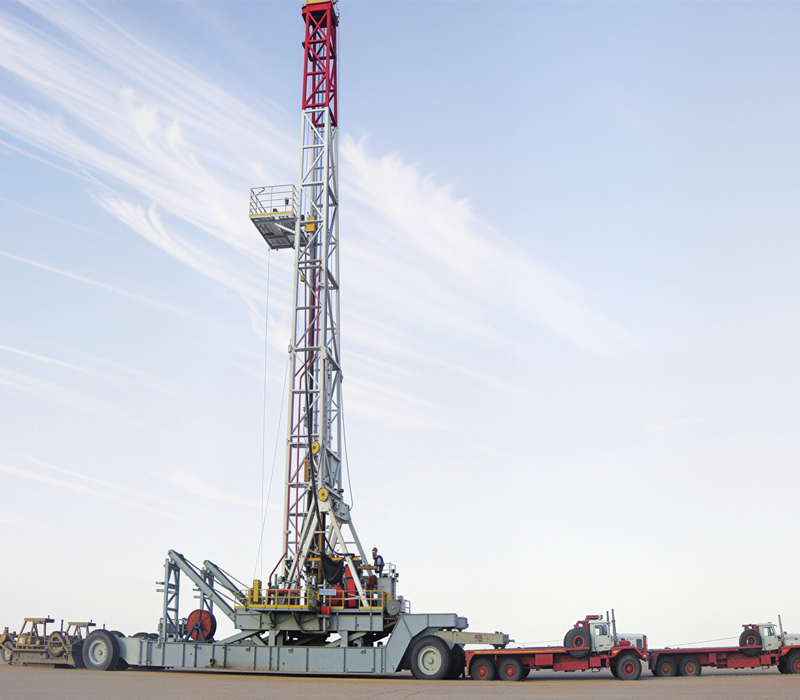
For frequent moves between scattered wells, the truck-mounted unit is the baseline. The rig travels as one road unit on its own chassis: the ZYT workover range runs from about 10.6 m long and 22.8 t on the 150HP model to about 13.9 m and 31.5 t on the 250HP and 350HP models, with the drive configuration stepping from 6×4 up to 12×8 all-terrain on the heavy classes. A self-propelled move avoids the crane, the low-bed trailer and most of the permit work, and it rigs down and up in hours rather than days. The cost is the chassis itself — bought with the rig, maintained with the rig, and justified only when the move count is high enough.
Method 2: Trailer and crane moves for skid equipment.
For skid-mounted equipment, every move is a project: crane and low-bed hire, road permits for the loads, rig-up and rig-down labour, and the foundation or pad work at the new location. The skid unit has a lower first cost and simpler maintenance, but the per-move cost is the highest of the three methods. This is the choice to make when the unit stays at one station or one well cluster for months and moves rarely. If the programme starts moving frequently, the per-move cost accumulates quickly against the price difference with a self-propelled or moving-system configuration.
Method 3: Integrated rig moving systems for fixed rigs that travel.
For skid rigs and heavy units that must relocate without a crane-and-trailer project, the integrated land rig moving system moves the rig as a controlled travel. The ZYT system is rated for 300-480 t of total rig weight, with a moving capacity of 400-540 t, a ground clearance of about 600 mm and a road speed up to 8 km/h, designed for road widths around 12 m and an ambient range of -17 to +55°C. Mast moving equipment and substructure moving equipment are offered separately, so the scope can be limited to the parts of the rig that actually travel. The system converts a multi-day crane-and-trailer move into a controlled travel, which changes the economics of a relocating skid rig completely.
| Method | Typical move time | Per-move cost | Best duty |
| Self-propelled truck-mounted | Hours (rig-up/down only) | Low (fuel, crew) | Frequent moves, scattered wells |
| Trailer and crane | Days | High (crane, trailer, permits) | Rare moves, fixed stations |
| Integrated rig moving system | Controlled travel, up to 8 km/h | Mid (system amortized) | Regular moves of skid and heavy rigs |
Step 1: Count the moves and the distances.
Build the move plan from the field map: the well count, the distance between pads, the road network and the expected move frequency per year. For each method, write down the per-move cost and the crew time, multiply by the annual move count, and compare the three totals over the planned operating years. This calculation is the same one that separates the truck-mounted and skid-mounted configurations — the number of moves is the deciding input.
Step 2: Check the road and permit envelope.
Every move is limited by the road envelope: axle loads, bridge ratings, road widths, overhead clearances and the permit regime of each region. Confirm the loaded weight, the moving dimensions and the axle configuration of the unit against the planned routes before committing the equipment. For the heavy truck-mounted classes on 12×8 chassis, the turning space and the bridge ratings are the practical limits; for the moving system, confirm the route width against the design figure (around 12 m) and the ambient range for the region.
Step 3: Include the rig-up and rig-down time.
The cost of a move is mostly crew time. Count the rig-down hours, the travel, the rig-up hours and the well-control re-fit at the new location for each method. A self-propelled unit that rigs down and up in hours versus a skid move measured in days changes the annual capacity of the rig: in a multi-well programme, the time saved per move is production capacity recovered.
Step 4: Match the moving scope to the parts that travel.
Not every rig travels whole. For skid rigs, confirm which components move — mast, substructure, drawworks, mud tanks, generator sets — and size the moving scope to that set. The ZYT mast moving and substructure moving equipment are quoted separately for exactly this reason: a rig that moves its mast but leaves its tanks at the station does not need the full-system capacity. State the parts that travel in the inquiry so the moving scope is not oversized.
What to send for a moving-related inquiry.
Send the well count and move frequency, the distances and road conditions on the route, the rig class and the parts that travel, the axle and permit constraints of the region, and the quantity of moving systems or transport equipment required. With the move plan, the supplier can confirm the chassis, the moving system rating or the transport scope that matches the operating model rather than a generic machine list.