 Buyer reference
Read the specification before comparing the price.
Two quotations for the same model name can differ in every column that matters: hook load versus maximum hook load, working depth for one string size versus another, pump input power versus engine rating. The terms below are the ones buyers encounter when they open a rig specification, a tender document or a certificate. Each term is given a short definition and the practical point to check when buying equipment.
The examples refer to the published parameters of the ZYT range so the terms are tied to real figures. Where a term belongs to a specific product page, the link is given.
Rig structure and hoisting terms.
Structure and hoisting terms| Term | Definition | What to check when buying |
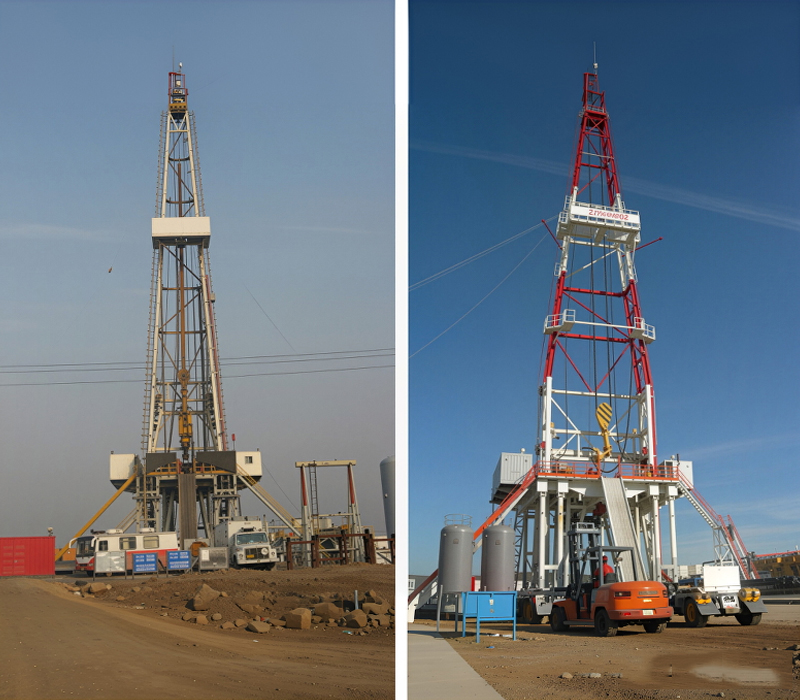
| Mast / derrick | The vertical structure that supports the traveling block and the drill string stands. | Clear height (e.g. 21 m to 39 m across the ZYT truck-mounted workover range) sets the stand length the rig can handle. |
| Substructure | The base that raises the rig floor above the wellhead and carries the mast and the drawworks. | Height (7.5 m to 10.5-12 m on the skid drilling classes) sets the BOP and wellhead clearance. |
| Drawworks | The hoisting winch that spools the drill line and moves the traveling block. | Input power (735 kW to 2210 kW on the skid classes) and drum capacity decide hoisting duty. |
| Crown block / traveling block | The sheave assembly at the top of the mast and the moving block hung on the hook. | The traveling system (5×6 to 7×8) sets how many rope lines carry the load. |
| Hook load | The load carried by the hook during operations. | Compare nominal (normal service) and maximum (reserve) separately; never mix the two bases. |
| Fast line | The end of the drill line that spools onto the drawworks drum. | Fast-line pull (210-280 kN in the ZYT mobile rigs) limits the hoisting force before the block ratio is applied. |
| Drill line | The wire rope reeved through crown and traveling blocks. | Rope diameter and effective line count (e.g. Φ26 mm / 8 lines) decide the hook load for a given pull. |
| Stand | A section of drill pipe racked in the mast, usually two or three joints. | Mast clear height decides the maximum stand length and tripping speed. |
| Rotary table | The rotating table in the rig floor that turns the drill string on rotary drilling rigs. | Opening size (700 mm to 1257.3 mm on the skid classes) limits the casing sizes that pass through. |
Mud circulation and solids-control terms.
Circulation terms| Term | Definition | What to check when buying |
| Mud pump | The pump that circulates drilling fluid down the drill string and back up the annulus. | Pump package (2×1300HP to 3×1600HP on the skid classes) sets the circulating rate. |
| Mud tank | The tank that stores and conditions the drilling fluid. | Effective capacity (180 m³ to 600 m³) caps the circulating volume; small tanks limit a big pump. |
| Solid control | The equipment train that removes cuttings and solids from the mud. | Shale shaker, desander, desilter and centrifuge scope belongs in the package quotation, not in accessories. |
| Circulating rate | The volume of fluid moved through the well per unit of time. | Compare the rate against the well program; a high-rate program needs matched tank and manifold capacity. |
| Manifold | The pipe and valve arrangement that routes the high-pressure fluid. | The high-pressure manifold rating must match the pump rating and the job pressure. |
Power, drive and control terms.
Power and control terms| Term | Definition | What to check when buying |
| AC-VFD-AC | Variable-frequency AC drive: the drawworks, rotary table and pumps run on VFD-fed AC motors with stepless speed regulation. | Compare torque control and smoothness against mechanical drives; the skid drilling classes in the ZYT range all use AC-VFD-AC. |
| SCR (silicon-controlled rectifier) | An older electrical drive form using controlled DC rectification for the motors. | Less common in new rigs; state AC-VFD-AC or SCR explicitly if the tender names a drive type. |
| Diesel generation | The generator set that supplies the rig electrical load. | Generation scope (3×1000 kW to 5×1200 kW on the skid classes) must cover the pump motors at peak load. |
| Engine rating | The power output of the prime mover (e.g. CAT C15, C18). | Engine rating is not the same as pump input power or drawworks power; ask for each separately. |
| Transmission | The gearbox or converter that connects the engine to the driven equipment. | On truck-mounted units the transmission (e.g. Allison M5620AR) serves both road and pump drive; confirm the duty rating. |
Cementing, fracturing and well-control terms.
Cementing and well-control terms| Term | Definition | What to check when buying |
| Cementing unit | The pump and mixing package that places cement slurry in the well. | Working pressure (70 MPa in the ZYT cementing trucks) and displacement (about 100 m3/h) are the first two filters. |
| Displacement | The volume of fluid a pump moves per unit of time. | Theoretical displacement changes with the drive form; confirm hydraulic or mechanical drive in the inquiry. |
| Slurry density | The weight of the cement slurry per volume, controlled during mixing. | State the density range (1.0-2.4 g/cm3 in the ZYT units) and accuracy tolerance (about 0.024 g/cm3). |
| Densitometer | The instrument that measures slurry density in real time. | Ask whether the densitometer is included and how it is calibrated; the job is judged on recorded density curves. |
| Plunger pump | A positive-displacement pump using reciprocating plungers for high pressure. | Triplex plunger pumps (3ZB-265, 3ZB-300) drive the cementing and fracturing duty; confirm wetted materials for the fluid. |
| BOP (blowout preventer) | The wellhead safety stack that seals the well under pressure. | Confirm the BOP fit against the mast clearance and substructure height, and state the well-control requirement in the inquiry. |
| Wellhead | The surface termination of the well casing. | Casing programme and wellhead size set the rotary table opening and substructure clearance. |
Workover and well-service terms.
Workover terms| Term | Definition | What to check when buying |
| Workover | The repair and maintenance of an existing well, including tubing change, pump repair and remedial work. | Depth, tubing size and hook load decide the rig class; the ZYT workover range covers 2,600 m to 9,000 m. |
| Well intervention | Any operation performed on a live or produced well, from logging to stimulation. | Coiled tubing, wireline, swabbing and snubbing scope should be listed in the same inquiry as the rig. |
| Swabbing | Unloading the well by pulling fluid with a swab on wireline or rod. | Swabbing unit and tool duty follows the depth and the fluid level to be pulled. |
| Coiled tubing | Continuous tubing run into the well for intervention without a full workover. | Reel capacity, injector pull and pressure rating decide the coiled tubing truck scope. |
| Wireline | Braided or slick line used to run tools in the well for logging and service. | Confirm the drum capacity and the pressure control equipment for live-well wireline work. |
| Flushing | Cleaning the flow line or tubing with pumped fluid. | Flow rate and pressure of the flushing truck are matched to the line size and the deposit type. |
| Paraffin removal | Removing wax deposits from tubing and flow lines. | Hot-oil boiler truck duty and flushing rate are sized to the wax load and the season. |
Compare quotations on the same terms.
Open the quotation and the specification side by side, and translate every column with these definitions before comparing suppliers. Check that the depth figure names the string size, that the hook load column distinguishes nominal from maximum, that the pump figures distinguish engine rating from pump input power, and that the tank and manifold scope appear as line items rather than accessories. If a term is missing or a basis is unclear, ask the supplier to state the basis in writing before the comparison is made.