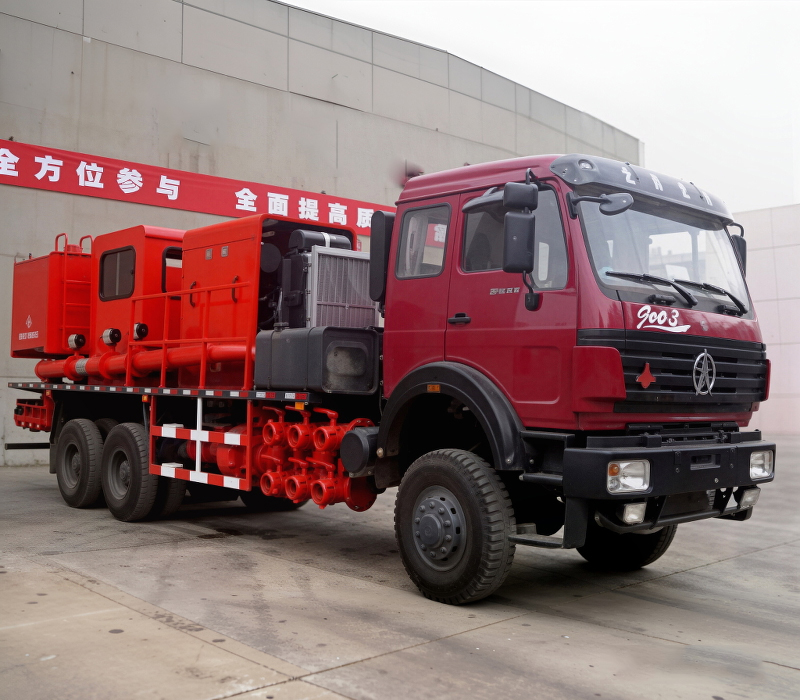
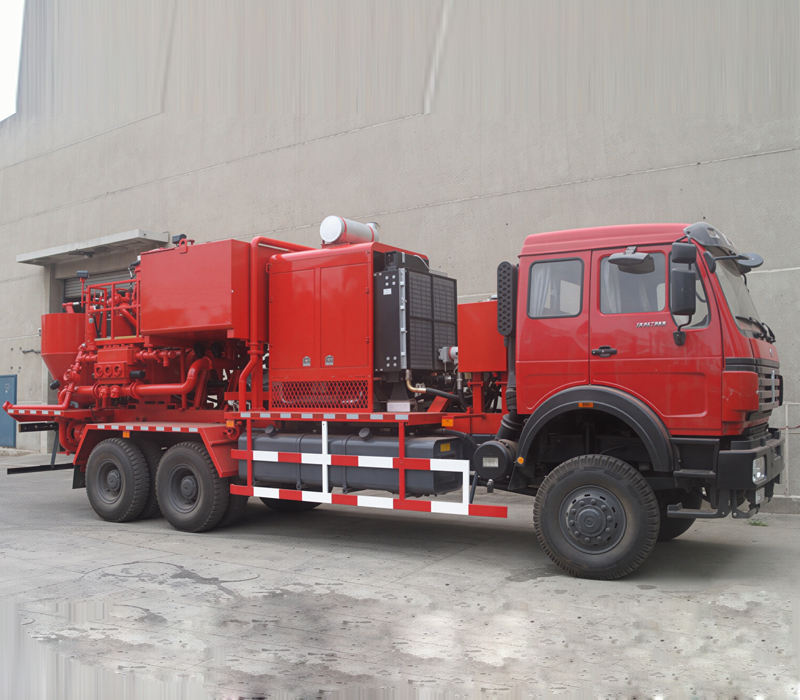
Single Pump Cementing Truck oilfield equipment
Cementing & Fracturing Equipment

Single Pump Cementing Truck

One 3ZB-265 or 3ZB-300 triplex pump, mounted on a Beiben ND2254F50J 6x6 chassis, delivers 70 MPa maximum working pressure and 100 m3/h theoretical displacement for the cementing job that does not need a twin-pump spread. A Detroit S60 at 475 hp and 2100 rpm drives it through an Allison 4700 ORS gearbox, and the mixing circuit still handles 1.0-2.4 g/cm3 slurry at up to 2.3 m3/min while holding density to +/-0.024 g/cm3. The trade is deliberate: a single pump gives up on-board redundancy, but in exchange the truck is lighter, simpler to service and cheaper to run on routine primaries, squeeze jobs and wellbore repairs at conventional and medium depth.

Core advantages

Designed around the operating requirement.

Single 3ZB pump, 70 MPa / 100 m3/h

One 3ZB-265 or 3ZB-300 triplex pump carries the full 70 MPa rating and 100 m3/h theoretical displacement, the rating a conventional primary or squeeze cement actually uses. There is no second pump to sync, so the control path stays short and easy for a two-person crew.
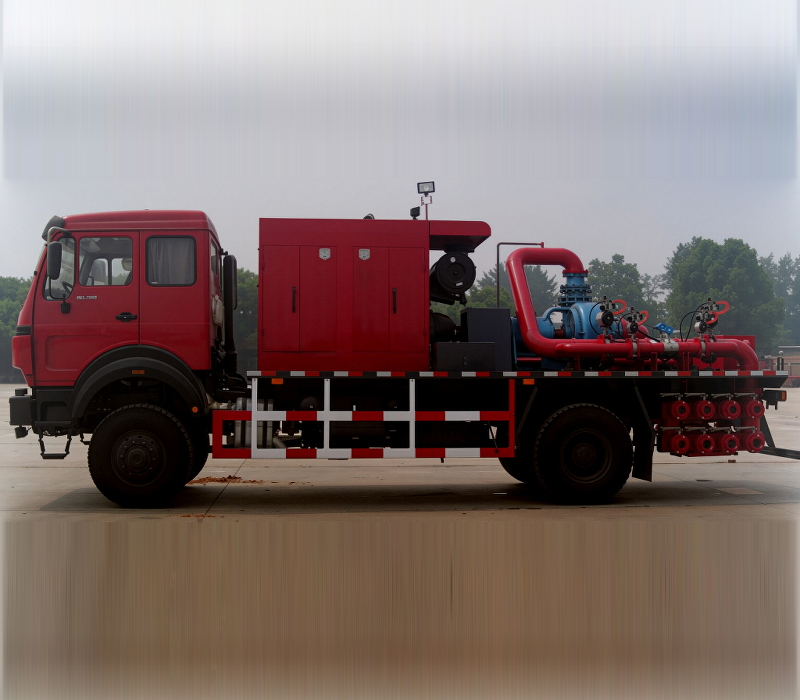
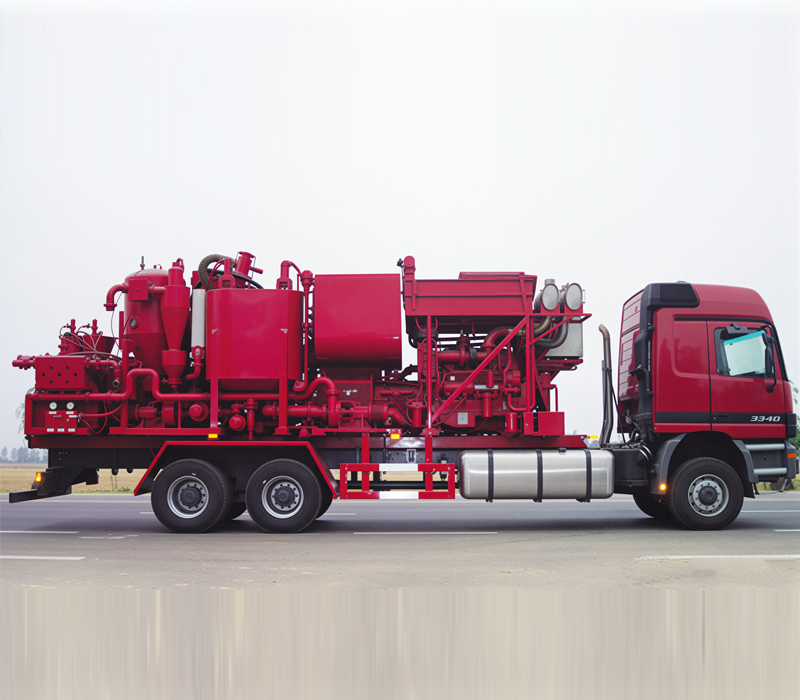
Mixing to +/-0.024 g/cm3

Despite the single-pump layout, the plant blends 1.0-2.4 g/cm3 slurry at up to 2.3 m3/min and holds density to +/-0.024 g/cm3, matching the accuracy of the heavier twin-pump truck. Cement design is not compromised when the number of pumps is.

Beiben 6x6, Detroit S60 drivetrain

The same Beiben ND2254F50J 6x6 chassis and Detroit S60 / Allison 4700 ORS drivetrain used on the twin-pump truck carry this unit, but with only one pump to drive the engine is sized for average load rather than peak. That cuts fuel use on the many routine wells a fleet runs.

Compact layout for narrow pads

With one pump decked instead of two, the truck is shorter and easier to position on a narrow well pad or a tight cluster-well location, and it rigs up with the same two-hose connection as the larger unit. Mobilization time between wells stays low.

Simpler maintenance path

Fewer pumps means fewer liners, valves and seal sets to stock, and the shared Detroit-Allison drivetrain keeps spares common across the cementing fleet. Routine inspections focus on one fluid end rather than two.

Day-in, day-out field duty

The unit is specced for the steady cycle of everyday cementing rather than the occasional deep emergency, running through summer and winter field campaigns on the same wear-part schedule. It is the economical choice when a twin-pump truck would be over-spec for the well.

Product Overview
ProductSingle Pump Cementing Truck
Product lineCementing & Fracturing Equipment
Technical Specifications
Max. working pressure (MPa)70
Max. theoretical displacement m3/h100
Max. slurry densityGeneral condition: 1.0~2.4g/cm3
Accuracy range±0.024g/cm3
Max. slurry-mixing capacity0~2.3 m3/min
Working mediumWater, slurry, drilling fluid
ChassisBeiben: ND2254F50J, 6×6
EngineDetrolit: S60 475@2100RPM
Transmission caseAllision: 4700○FS(5F + idle)
Triplex plunger pump3ZB-265,3ZB-300 (Optional)
Application

Where this equipment is used.

  • Cementing jobs that do not need a twin-pump spread: one 3ZB-265 or 3ZB-300 pump at 70 MPa and 100 m³/h.
  • Lighter, simpler service and lower mobilization cost than a twin-pump unit for conventional primaries.
  • slurry density held from 1.0 to 2.4 g/cm³ while mixing at up to 2.3 m³/min within ±0.024 g/cm³.
  • Medium-depth primary and remedial cementing on the Beiben ND2254F50J 6×6 chassis.
  • Rapid redeployment between pads on the truck-mounted unit.
Next step

Send the operating requirement.

For a useful technical response, include the target well conditions, operating depth or pressure, expected quantity, destination and any required configuration.

Send an Inquiry
Configuration

Options for a matched equipment scope.

Available configurations can be matched to the equipment model, operating conditions and project requirements.

  • Pump set: 3ZB-265 or 3ZB-300 selected against the pressure and rate requirement.
  • drive: detroit s60 475 hp through an allison 4700 ors as standard; engine and gearbox alternatives on request.
  • mixing and density: automatic density control tuned to the slurry recipe and programme.
  • Well-control fit: manifold and cement head matched to the casing programme.
  • Documents and after-sales for Single Pump Cementing Truck: operation manuals, factory test report and first-period spares are included; on-site commissioning and crew training can be arranged.
Buyer questions

Frequently asked about this equipment.

The single pump cementing truck questions that matter most are working pressure, displacement and drive form.

What working conditions is the Single Pump Cementing Truck suitable for?

The single-pump truck is sized for conventional primaries, secondary squeeze jobs, wellbore plugging and remediation on 0-4500 m shallow and medium-depth wells, putting one 3ZB-265 or 3ZB-300 pump through 70 MPa and 100 m3/h. On a cluster-well batch program or a narrow pad where the twin-pump truck is over-spec and hard to position, this unit rigs up with the same two-hose connection at lower mobilization and running cost.

What are the advantages compared with double-pump cementing trucks?

This single-pump model features compact structure, flexible transfer and lower comprehensive energy consumption. It avoids redundant power output of large units under medium and small cementing load conditions, with simpler operation, lower failure rate and more economical maintenance cost. It is the optimal cost-effective equipment for conventional daily cementing tasks.

Can the equipment hold stable constant-pressure cementing?

Yes. The hydraulic stepless drive trims pump speed against the job line, holding pressure and rate near the set point through the placement, while the mixing circuit keeps density to +/-0.024 g/cm3. Pressure, rate and density are logged for the cementing report, so the slurry column arrives at the casing uniform instead of drifting on manual control.

Does it support extreme climate field operation?

Yes. The truck is built for year-round cementing service, with the Detroit S60 drivetrain and Beiben 6×6 chassis matched to rough-site and cold-climate duty; low-temperature start and heat-preservation provisions are configured to the operating site. Confirm the ambient range in the inquiry so the winterising scope is included in the quotation.

Can personalized parameter upgrading and configuration customization be carried out?

Yes. We support customized upgrades such as high-pressure boost, intelligent precise mixing, explosion-proof configuration, remote monitoring and wear-resistant reinforcement, which can be flexibly matched according to customer’s actual well depth, pressure requirements and oilfield working conditions.

Procurement information

Ordering this equipment.

Commercial terms are confirmed in the quotation for the exact configuration, quantity and destination.

Certification & standards

Manufactured to API oilfield equipment standards at the Jingzhou plant under ISO 9001:2015 quality management, with the 3ZB pump pressure-tested to 70 MPa and the mixing circuit calibrated to the +/-0.024 g/cm3 density accuracy before dispatch; certificate scope and applicable standards are listed in the quotation.

Documentation

Cementing unit manuals, pump performance curves and pressure-vessel test reports are supplied; the batch mixer and manifold drawings are provided for integration with the client's cementing spread.

Lead time

Confirmed in the quotation according to configuration, quantity and destination.

Warranty & after-sales

Manuals, conventional spare parts and remote technical guidance are included; on-site commissioning and operator training can be arranged on request.

Payment & delivery

Payment schedule, Incoterms, port and packaging are agreed in the sales contract.

Spare parts

A recommended spare-parts list for the first operating period is provided with the quotation.