
100 to 200 t moving capacity for auxiliary skids
The skidding frame moves mud-pump, power-unit, manifold and control-cabin skids at a 100 to 200 tonne rated capacity, the auxiliary side of the site rather than the main rig weight.
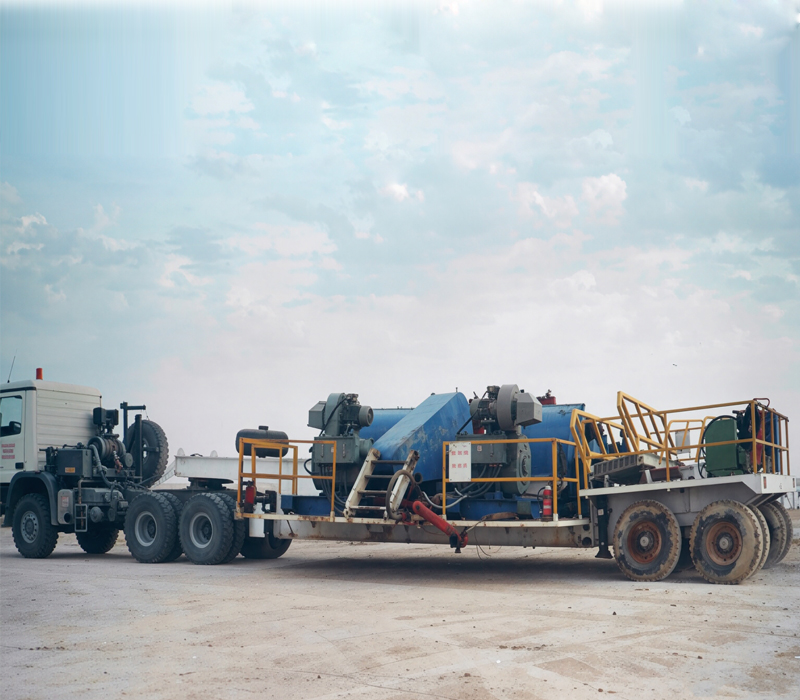
Where the main rig carrier moves 300 to 480 tonnes, this system moves the support side: generator-room and auxiliary skid sets of 80 to 160 tonnes, with a moving capacity of 100 to 200 tonnes on a 3-1/2 inch traction pin. The narrower footprint shows in the numbers, a 6,600 mm required road width and 500 mm ground clearance against the 12 m-wide main mover, because mud-pump skids, power units, manifold skids, control cabins and solid-control units follow tighter pad routes than the rig itself. At 8 km per hour maximum, multi-point hydraulic skidding carries each ancillary unit intact, piping and wiring still connected, so the auxiliary spread re-positions without a teardown. It is the companion to the whole-rig carrier, sized to the 150 to 850 hp workover range but rated for the lighter, dispersed loads that cluster-well campaigns generate.
The skidding frame moves mud-pump, power-unit, manifold and control-cabin skids at a 100 to 200 tonne rated capacity, the auxiliary side of the site rather than the main rig weight.
Generator-room set trailers of 80 to 160 tonnes ride on the system, with the 3-1/2 inch traction pin rated to pull the dispersed support spread between well slots.
The 3-1/2 inch traction pin and 6,600 mm road-width allowance set the compact footprint that lets auxiliary skids follow tighter pad paths than the 12 m-wide whole-rig carrier.
500 mm minimum ground clearance keeps the skid frame clear of culverts and pad obstacles on the narrower routes the support equipment travels.
Multi-point hydraulic skidding lifts and shifts the ancillary skid as one unit, so pipelines, wiring harnesses and fixed connections stay intact and no post-move re-teardown is needed.
The support units follow the main rig at up to 8 km per hour, repositioning with the cluster-well campaign so the mud, power and control spread lands when the rig does.
| Product | Moving System for Drilling Rig Matched Equipment |
|---|---|
| Product line | Rig Moving Systems |
| Performance | Design parameter |
|---|---|
| Max total weight of generator room-set trailer (t) | 80~160 |
| Max moving capacity of Generator room trailer | 100~200 |
| traction pin model | 3 1/2〞 |
| Min clearance from ground (mm) | 500 |
| Max moving speed (km/h) | 8km/h |
| Width of application road (mm) | 6600 |
For a useful technical response, include the target well conditions, operating depth or pressure, expected quantity, destination and any required configuration.
Send an InquiryAvailable configurations can be matched to the equipment model, operating conditions and project requirements.
Buyers evaluating matched moving equipment usually ask which rig components travel and the rated capacity.
No disassembly required. The auxiliary equipment travels on its own skid as one integrated unit — piping, wiring and fixed fittings stay connected — so the move is a lift-and-place rather than a strip-and-rebuild. This avoids component loss and alignment drift between wells, which is the failure mode that eats the move window on multi-well pads.
The system carries the support side of the 150 hp to 850 hp workover fleet: mud-pump skids, power-unit skids, hydraulic-manifold skids, electrical control cabins and solid-control units. The adjustable skid frame is set at order time to the footprint and load of each auxiliary unit in the spread, so the generator-room set and the mud skid move on the same 100 to 200 tonne carrier rather than separate trucks.
Yes. The skid mover carries each auxiliary unit on multi-point hydraulic skidding that keeps the load platform level through the move, so piping and wiring stay connected and the skid lands level at the next slot without a secondary levelling crew. The 100–200 tonne moving capacity and 6,600 mm road-width envelope are the published numbers to check against the heaviest generator-room or mud-pump skid in the spread.
A traditional move lifts each auxiliary skid separately and hauls it by truck, which adds crane time, risks pipeline damage and needs re-levelling on arrival. This system shifts the mud-pump, power-unit and manifold skids as a synchronized set on their 100 to 200 tonne frame, piping and wiring still connected, at up to 8 km/h. The auxiliary spread lands when the rig does, with no second re-levelling or pressure testing of the lines.
Intelligent options are scoped to the auxiliary spread rather than the main rig: load-balancing correction across the generator-room trailer and the mud and power skids, real-time stress and flatness readout on the 100 to 200 tonne skidding path, and remote wireless operation from the control cabin. Because these units move at 8 km per hour on 6,600 mm routes with a 3-1/2 inch traction pin, automatic fault alarm on the hydraulic locks and clearance monitoring at the 500 mm figure can be added at order time.
Commercial terms are confirmed in the quotation for the exact configuration, quantity and destination.
Built to API 4F and API 7K at the Jingzhou plant under ISO 9001:2015 quality management; the hydraulic skidding frame is proved to its 100 to 200 tonne moving capacity on 80 to 160 tonne generator-room sets, and the 3-1/2 inch traction pin is load-checked before dispatch. The certificate scope is listed in the quotation.
Operation and maintenance manuals, chassis documentation and factory test reports are supplied; the hydraulic and electrical schematics are included for the client's service department.
Confirmed in the quotation according to configuration, quantity and destination.
Manuals, conventional spare parts and remote technical guidance are included; on-site commissioning and operator training can be arranged on request.
Payment schedule, Incoterms, port and packaging are agreed in the sales contract.
A recommended spare-parts list for the first operating period is provided with the quotation.
Explore nearby products to compare equipment scope before sending an inquiry.
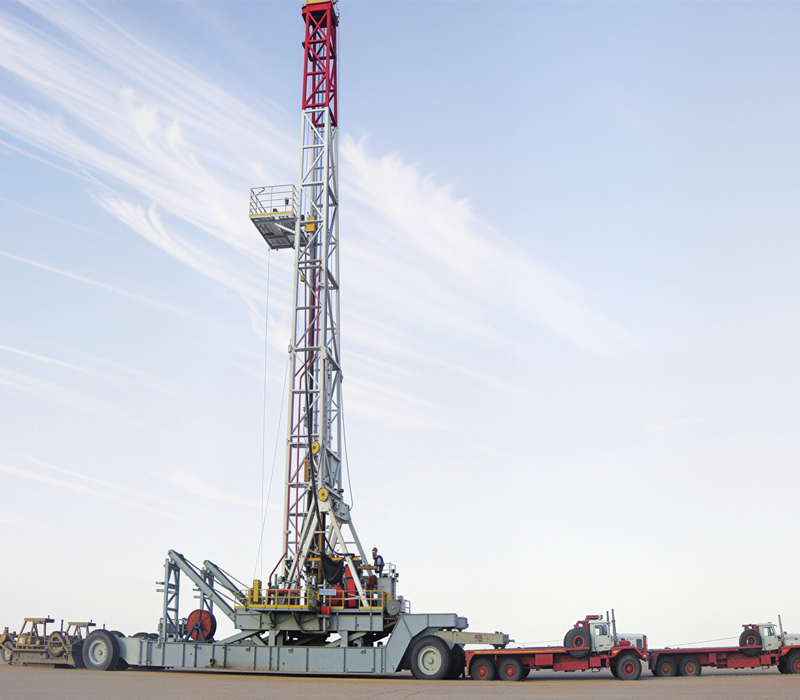
Designed to carry a whole 300 to 480 tonne land rig without splitting it, this self-propelled moving system is rated to shift up to 400 to 540 tonnes in solid-moving configuration, with mast, drawworks, power pack and…
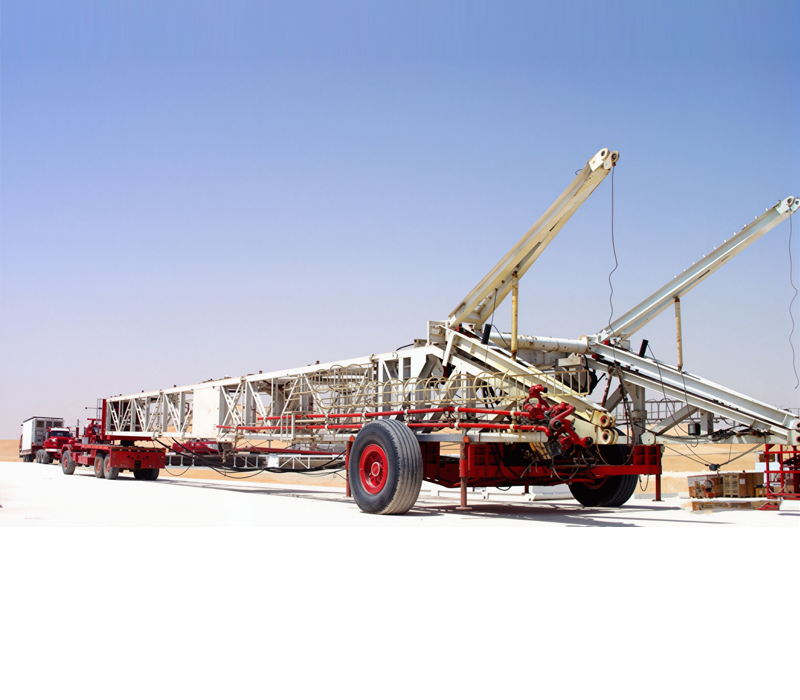
This carrier is purpose-built for the folded telescopic mast: 80 to 150 tonne rig masts move on a 100 to 180 tonne rated frame, at 10 km per hour, with 600 mm clearance and an 11,000 mm road-width allowance.
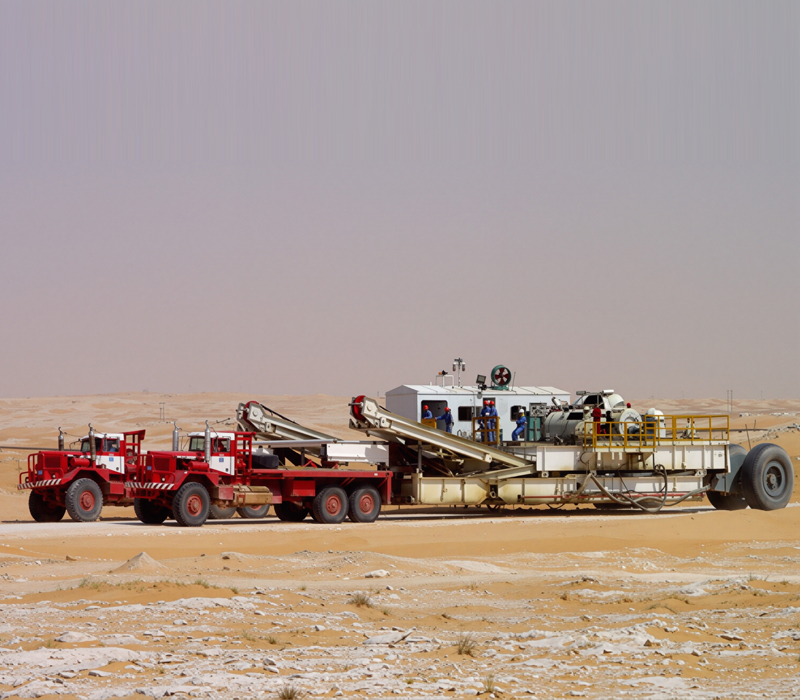
The rig substructure is the bottom 180 to 330 tonne block of the rig, and this skid mover is rated to shift it at 220 to 390 tonnes capacity, 10 km per hour, with 600 mm clearance on a 12,000 mm road width.