
One interface owner
One supplier confirms the tank volume, the manifold rating, the control wiring and the spare-parts list as a set, so compatibility questions are answered before shipment instead of during rig-up.
A complete package is more than a rig: the pumping scope, the power supply, the relocation system and the support trucks have to be sized for the same depth, pressure and site plan. The package is assembled in four layers and confirmed against the well program before quotation.
 Package logic
Buyers often compare quotations machine by machine, but a wellsite package works as one system. The rig, the pumping units, the power package and the support vehicles share the tank capacity, the manifold rating, the control wiring and the same spare-parts pool. When each item is bought separately from different suppliers, the interfaces are discovered on site: the cementing truck arrives with a manifold that does not match the rig floor, the power unit is short of the pump motor rating, or the moving system is rated below the rig weight it has to carry. A matched package closes those gaps before the equipment ships.
The ZYT range covers the full set from one manufacturer: skid-mounted and mobile drilling rigs, truck-mounted workover rigs, cementing and fracturing units, power equipment, rig moving systems and the support truck fleet. Because the parameters are published, the package can be assembled against the numbers instead of against marketing descriptions.
One supplier confirms the tank volume, the manifold rating, the control wiring and the spare-parts list as a set, so compatibility questions are answered before shipment instead of during rig-up.
Manuals, test reports, loading documents and certificates are consolidated for the whole scope, which simplifies the import, customs and commissioning process at the destination.
Rig, pumping and support units arrive and are commissioned on a shared schedule, so the well program is not delayed by a unit that arrives as a loose end.
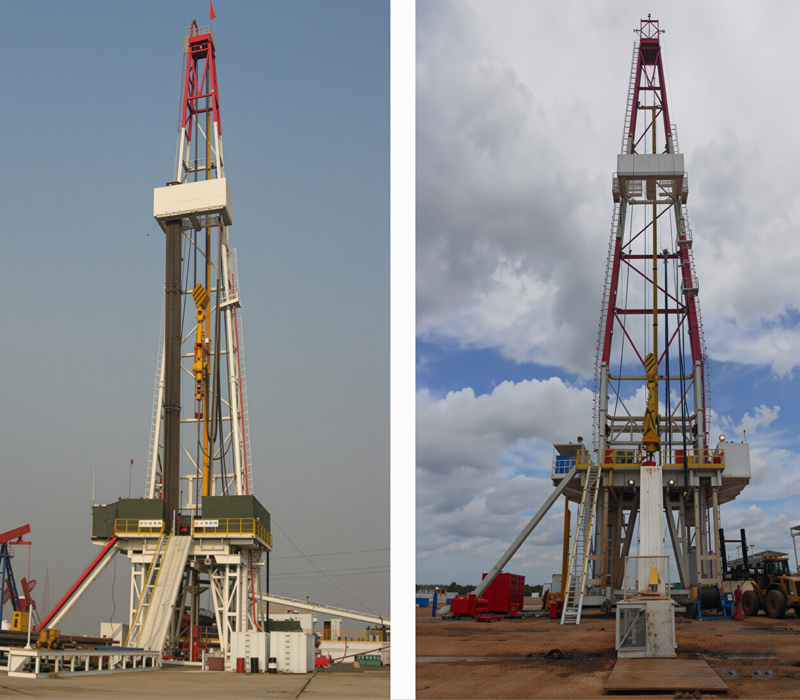
The rig decides the class of the whole package. For a fixed drilling programme, the skid-mounted range is sorted by depth and hook load: the 1000HP class covers 2500-4000 m on 114mm drill pipe with a 2250 kN maximum hook load, the 1500HP class reaches 3500-5000 m at 3150 kN, the 2000HP ZJ70DB class reaches 4500-7000 m at 4500 kN, and the 2500HP ZJ80 class reaches 6000-9000 m at 6750 kN. For programmes that must move between pads, the mobile rigs cover 3000 m (1800 kN maximum load) and 4000 m (2250 kN) on their own carriers, while the truck-mounted drilling rigs from 250HP to 850HP handle the shallow to medium drilling band. The choice between skid and truck-mounted form follows the relocation count and the site foundation, not the depth alone.
For workover and well-service programmes, the truck-mounted workover rig range from 150HP to 850HP covers working depths from 2,600 m to 9,000 m (73mm tubing), with hook loads rising from 585 kN to 2,250 kN. A package built around workover uses the rig as the core and the support trucks as the service layer, which is Layer 4.
The pumping scope follows the pressure and the displacement the program needs. In the ZYT range, the single-pump and double-pump cementing trucks are rated 70 MPa maximum working pressure with about 100 m3/h maximum theoretical displacement on a 3ZB-265 or 3ZB-300 triplex plunger pump; the 400-type truck is rated 40 MPa and the 700-type 70 MPa, so the drive form and the pressure class must be stated in the inquiry. For stimulation work, the fracturing pump truck is a positive-displacement unit rated 105 MPa and 2,719 L/min, and the acid pump truck uses a centrifugal pump rated 1,000 m3/h at 45 m head for acidizing and plug removal. The skid-mounted cementing unit covers fixed-station duty with a 300 kW pump input and up to 70 MPa.
Fluid supply sits in the same layer: the fluid supply truck is rated 750 m3/h at 45 m head, and the bulk cement truck carries the dry cement for batch jobs. The tank volume, the manifold rating and the densitometer package belong to this layer, because a cementing or fracturing job is judged on the recorded density, pressure and volume curves, not on the pump badge.
For drilling packages, the power scope is quoted with the rig: the skid classes run 3 × 1000 kW to 5 × 1200 kW diesel generation with AC-VFD-AC drive, and the mobile rigs carry their own CAT C15 or C18 power. The generator set equipment line (Volvo engine with Stamford alternator, 56-500 kWe prime at 50 Hz) covers site and workshop power where the rig power is not the right size.
For relocations, the land rig moving system is rated for 300-480 t of total rig weight with a moving capacity of 400-540 t, a ground clearance of about 600 mm and a road speed up to 8 km/h; mast moving and substructure moving equipment are offered separately so the scope can be limited to the parts of the rig that actually travel. A package that includes the moving system avoids the crane-and-trailer cost that otherwise appears in every relocation.
The support trucks complete the package for workover and well-service programmes: coiled tubing truck, wireline unit, swabbing unit and tool, well flushing and paraffin removal truck, boiler truck for heat work, logging truck, mobile workshop, instrument vehicle, truck with crane, gin pole truck and derrick carrying truck. Each unit is matched to a task in the program, and a typical shallow-workover package uses only a few of them. The instrument vehicle provides the control room with a Siemens PLC and 8-12 Motorola radio intercom sets for larger stimulation or batch jobs.
| Layer | Example ZYT equipment | Selection input |
| Main rig | 1000-2500HP skid rigs, 3000-4000m mobile rigs, 150-850HP workover rigs | Depth, hook load, relocation count, site foundation |
| Pumping | Single/double-pump cementing trucks (70 MPa), fracturing pump truck (105 MPa), skid cementing unit (70 MPa, 300 kW) | Pressure, displacement, fluid type, density accuracy |
| Power & moving | Diesel generation (56-500 kWe), land rig moving system (400-540 t), mast/substructure moving equipment | Power rating, rig weight, road conditions |
| Support fleet | Fluid supply truck (750 m3/h), coiled tubing truck, wireline unit, flushing/paraffin truck, instrument vehicle, mobile workshop | Task list from the well program |
A package quotation is prepared per line item, so the boundary is visible: which pumps, tanks, manifolds, controls and support trucks sit inside the quoted scope, and which are optional. The documentation set follows the same boundary — operation and maintenance manuals, factory test reports, loading documents and certificates are listed per item and consolidated for the whole scope. Confirm the certification level (for example API 4F on the structure and API 7K on power transmission components where they apply) and the commissioning scope before the order, because both change the quotation.
Send the operating task and the well program: depth and tubular size, the required hook load, the cementing or fracturing pressure and displacement, the fluid types, the relocation plan, the site access and foundation conditions, the quantity of wells, the destination port and the required documentation. With that set, the supplier can match the rig class, the pumping scope, the power and moving scope and the support fleet as one package and confirm the interfaces, the delivery window and the commissioning plan in one response.
These answers frame the package boundary; final scoping still depends on the well program and the site conditions.
A matched package fixes the interfaces between the rig, the pumping units, the power supply and the support trucks before quotation, so the tank volume, the manifold rating, the control wiring and the spare-parts pool are sized for each other instead of being discovered on site.
The main rig, the cementing or fracturing pumping scope, the power package, the rig moving system for relocations, and the support vehicles such as fluid supply, instrument, coiled tubing and flushing trucks. The exact list follows the well program and the site.
The supplier matches the rig class to the depth and load, the pumping units to the pressure and displacement, and the support scope to the operating task, then confirms the interfaces, documentation and commissioning in one quotation.
Yes. Packages are quoted per line item, so a rig can be added later, a pumping unit upgraded, or support trucks added as the field develops. Matching the initial interfaces keeps later additions compatible.