
 Buyer review
Start from the well programme, then compare the classes.
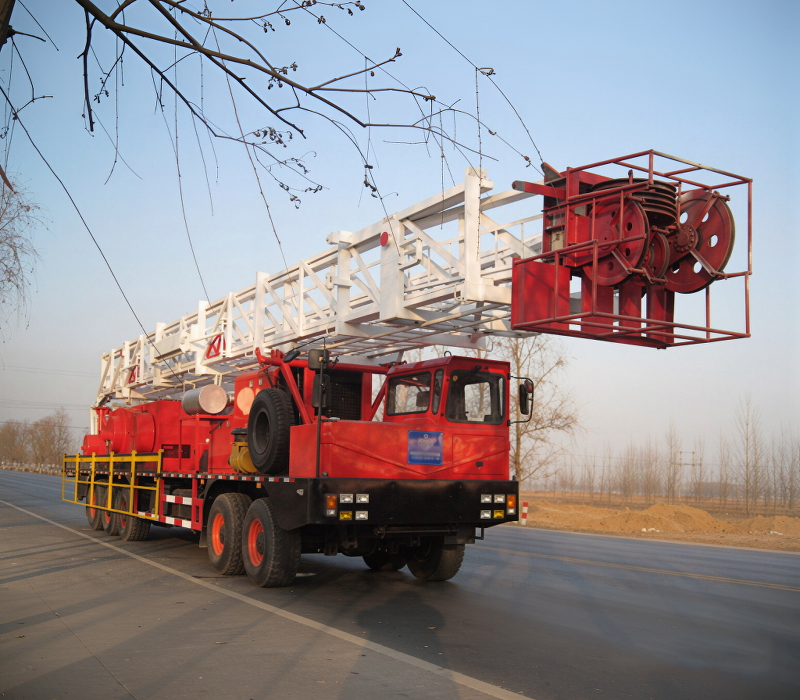
The names describe the duty. A drilling rig drills a new well: it carries the full circulating system, the well-control stack, the mud pumps and the power to turn a drill string continuously. A workover rig services an existing well: tubing change, pump repair, flushing, swabbing, remedial work. Because the duty differs, the structure, the depth rating and the mobility differ with it. A workover rig is lighter and faster to move; a drilling rig is heavier and slower, but it carries the scope that drilling demands.
The comparison uses the ZYT published ranges: the truck-mounted workover rigs from 150HP to 850HP, the skid-mounted drilling rigs from 1000HP to 2500HP, and the mobile drilling rigs at 3000 m and 4000 m.
Difference 1: The task and the operating cycle.
A drilling rig works a concentrated cycle: drill the hole, run the casing, complete and move. A workover rig works a repeated cycle on an existing well inventory: the same wells are serviced again and again as they decline, fail or need maintenance. The operating model drives the design. Workover rigs are built for frequent relocation and short rig-up times; drilling rigs are built for continuous duty at one location with a full support spread. In a mature field with dozens of wells, the workover rig is a recurring production tool; the drilling rig appears only when a new well is added.
Difference 2: The structure and the hoisting scope.
The structure reflects the load the rig has to handle. A workover rig's mast handles tubing and completion strings, with clear heights from 18 m on the 150HP class to 39 m on the 850HP class, and hook loads from 585 kN to 2,250 kN. A drilling rig's mast handles drill strings and casing programmes, with the skid classes rising to a 48 m mast and 6,750 kN maximum hook load on the 2500HP class. The traveling system grows from 5×6 lines on a 1000HP drilling rig to 7×8 lines on the 2500HP class, while the workover range stays in the 4×5 to 5×6 band. Heavier line counts mean heavier hoisting at the cost of speed — the trade each class makes for its duty.
Difference 3: The circulating and well-control scope.
The most visible difference is the mud system. A drilling rig carries the mud pumps, the mud tanks and the solids-control train because drilling fluid is part of the drilling process: the skid classes run 2×1300HP to 3×1600HP mud pumps with tank capacity from 180 m³ to 600 m³. A workover rig carries far less circulating scope — the fluid handling is usually provided by support units such as a fluid supply truck, a flushing truck or a cementing unit deployed alongside. The well-control stack also differs in scale: a drilling rig's BOP arrangement is sized for drilling pressures and casing programmes, while a workover rig's fit is sized for the tubing and completion work of an existing well. Confirm both against the well programme before the class is fixed.
Difference 4: Depth and mobility in numbers.
| Class | Typical depth | Max. hook load | Form and mobility |
| 150-350HP workover | 2,600-4,000 m | 585-900 kN | Truck-mounted, self-propelled |
| 450-850HP workover | 5,500-9,000 m | 1,125-2,250 kN | Truck-mounted, all-terrain chassis |
| 3000/4000m mobile drilling | 3,000-4,000 m | 1,800-2,250 kN | Truck-mounted, self-propelled |
| 1000-1500HP skid drilling | 4,000-5,000 m | 2,250-3,150 kN | Skid, fixed installation |
| 2000-2500HP skid drilling | 6,000-9,000 m | 4,500-6,750 kN | Skid, fixed installation |
Two bands overlap in practice. The 3000m and 4000m mobile drilling rigs sit between the workover fleet and the skid fleet: they drill to 4,000 m on their own carriers, which makes them the crossover choice for programmes that need real drilling capacity with workover-style mobility. The heavy workover classes (650HP and above) reach drilling depths on tubing work, so a field with an existing 650HP class can cover deep workover without a separate drilling rig.
Difference 5: Power and drive.
A drilling rig's power is sized for continuous drilling: the skid classes run 3×1000 kW to 5×1200 kW diesel generation with AC-VFD-AC drive across the whole range. A workover rig's power is carried on the chassis and serves the hoisting and the auxiliary systems, with engine ratings that trade speed and load per the model (the XJ250 reaches 1.5 m/s maximum hook speed, the heavier XJ350 is rated 1.1 m/s). When a programme crosses from workover into light drilling, compare the fast-line pull and the line count against the drill string weight — that is where the workover class reaches its limit.
Where one class does the other's job.
The boundary is real but not rigid. A workover rig drills shallow new wells within its rating — the 350HP truck-mounted class to about 1,000 m on 4 1/2-inch drill pipe, and the 450HP and 650HP classes further. A drilling rig performs workover tasks, but it is oversized and expensive to move for routine maintenance. For an operator planning a field, the practical pattern is: keep the workover fleet for the well inventory, bring the mobile or skid drilling rig for new wells, and use the crossover classes (mobile drilling rigs and heavy workover rigs) where the field mixes both duties.
What to state in the inquiry.
State the duty first: new wells, existing well maintenance, or both. Then give the depth and tubular size, the heaviest string or casing load, the circulating and well-control requirements, the relocation plan and the site conditions. With that set, the supplier can place the equipment on the right side of the line between workover and drilling, or choose the crossover class that covers both without paying for the wrong scope.