
 Buyer review
Define the duty before the equipment name.
Cementing equipment selection should start from the well program, the required pressure, the displacement, the fluid volume and the fluid characteristics. The pump, the tank, the manifold, the controls and the monitoring equipment should be reviewed together, because a quotation for a bare pump truck does not answer a cementing package requirement. The checklist follows the order in which the data should be collected: well data first, then pump duty, then mixing accuracy, then fluid compatibility, then the supporting units, then the commercial scope.
Step 1: State the well data and the cementing stage.
The first block of data is the well itself: depth, casing and tubing sizes, the planned cementing stage, and whether the job is primary cementing, a squeeze job, a plug job or a remedial operation. The stage defines the pressure and the volume. A shallow conventional job and a deep-well production cementing job place very different demands on the same equipment family, so the stage should be stated before any capacity comparison.
Collect the slurry volume for the planned stage as well, because it sizes the mixing capacity and the tankage. The volume follows from the annular space and the planned fill height, so casing and open-hole sizes are needed in the same round of data. When several wells are grouped in one tender, state the typical and the maximum stage volume separately, so the supplier can check the unit against the peak job, not only the average.
Step 2: Define the required pressure.
Pressure is the first equipment filter. In the ZYT range, the cementing trucks and the skid-mounted cementing unit are rated 70 MPa maximum working pressure, while the 400-type cementing truck is rated 40 MPa and the 700-type is rated 70 MPa. If the well program requires a working pressure at or near the unit rating, confirm how the rating is stated, whether it applies continuously or intermittently, and which safety and relief devices are included. A job planned at 60 MPa does not comfortably use a 70 MPa unit rated at continuous duty; check the duty basis with the supplier.
Step 3: Match the displacement and the pump configuration.
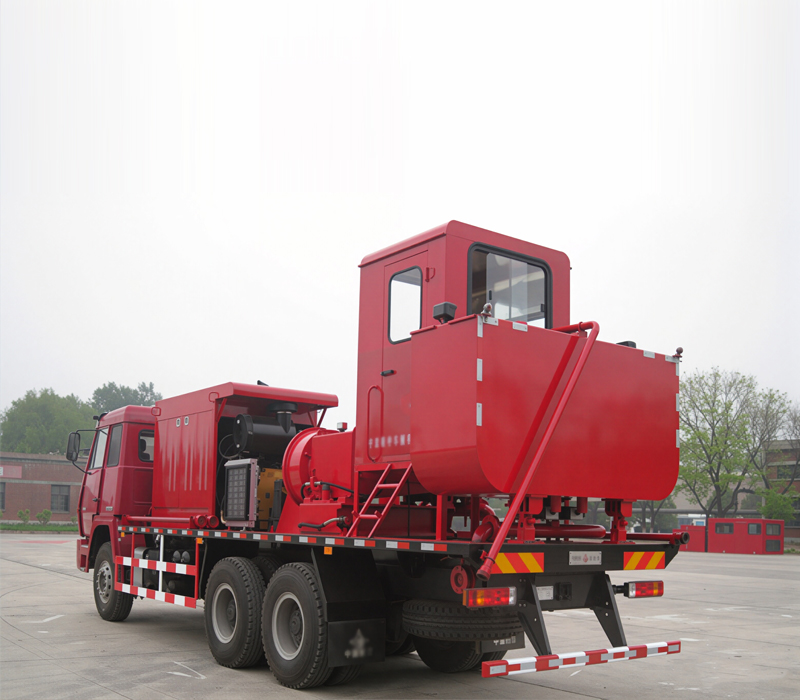
Displacement decides the pump size and whether one or two pumps are needed. The ZYT single-pump and double-pump cementing trucks are both rated 100 m3/h maximum theoretical displacement at 70 MPa working pressure, driven by a 3ZB-265 or 3ZB-300 triplex plunger pump. The double-pump configuration adds redundancy and higher continuous output for deep-well and large-volume jobs; the single-pump form is the compact option for conventional and shallow-medium depth work. The 400-type truck is rated 100 m3/h (hydraulic drive) or 71.8 m3/h (mechanical), and the 700-type is rated 60 m3/h (hydraulic) or 84 m3/h (mechanical), which shows that the drive form changes the published displacement and must be stated in the inquiry.
| Model | Max. pressure | Max. displacement | Drive form |
| 400-type cementing truck | 40 MPa | 100 / 71.8 m3/h | Hydraulic / mechanical |
| 700-type cementing truck | 70 MPa | 60 / 84 m3/h | Hydraulic / mechanical |
| Single-pump cementing truck | 70 MPa | 100 m3/h | 3ZB-265 / 3ZB-300 triplex |
| Double-pump cementing truck | 70 MPa | 100 m3/h | Two triplex pumps, one chassis |
| Skid-mounted cementing unit | 70 MPa | 84.6 m3/h | 300 kW pump input |
Step 4: Check slurry density control and mixing capacity.
Density control is what separates a cementing unit from a pressure washer. The ZYT cementing trucks hold slurry density in the range 1.0-2.4 g/cm3 with an accuracy of about 0.024 g/cm3, and the mixing capacity reaches 0-2.3 m3/min. State the density range and the accuracy tolerance required by your cement recipe in the inquiry, because the densitometer and the mixing system determine whether the recipe can be repeated job after job. For batch mixing, confirm the tank volume and the recirculation path as well.
Density accuracy is not a laboratory figure: it decides whether the cement column reaches the planned top and whether the plug behaves as designed. A densitometer that drifts beyond the tolerance of the recipe produces a column that is heavier or lighter than calculated, which shows up later as remedial work. State the required accuracy and the verification method in the inquiry, and ask how the unit is calibrated on site.
Step 5: Check fluid compatibility before choosing the pump.
The fluid type changes the wetted materials and the pump class. The same supplier family covers very different duties: the acid pump truck uses a centrifugal pump rated 1,000 m3/h at 45 m head for acidizing and plug removal, while the fracturing pump truck is a positive-displacement unit rated 105 MPa and 2,719 L/min for reservoir stimulation. Cement slurry, acid and fracturing fluid have different abrasive and corrosive effects, so state the fluid type, temperature and solids content, and ask which pump class and which wetted materials are offered for that fluid. A pump chosen for slurry may not survive an acid programme without the correct trim.
Step 6: Plan the supporting units and the monitoring scope.
Most cementing jobs are delivered by more than one unit. The supporting package typically includes a fluid supply truck (in the ZYT range rated 750 m3/h at 45 m head), the manifold and tank system, and the densitometer and monitoring unit. For larger stimulation or batch jobs, an instrument vehicle provides the control room: the ZYT instrument vehicle uses a Siemens PLC with analog input and output modules, a looped and star network control system, and 8-12 sets of Motorola radio intercoms for the crew. State which of these units belong in the package and which are already available at the site, because that boundary changes the quotation significantly.
| Unit | Key rating | Role |
| Fluid supply truck | 750 m3/h, 45 m head | Water and fracturing-fluid supply |
| Acid pump truck | 1,000 m3/h, 45 m head | Acidizing and plug removal |
| Fracturing pump truck | 105 MPa, 2,719 L/min | Reservoir stimulation |
| Instrument vehicle | Siemens PLC, 8-12 radio intercoms | Data collection and job control |
Step 7: Choose truck-mounted or skid-mounted for the site.
The same pumping duty is available in both forms, and the choice belongs to the site. Truck-mounted units relocate under their own power and need no foundation; skid-mounted units stay at fixed stations and well clusters. The selection method, including the cost test for the annual move count, is covered in the truck-mounted vs skid-mounted comparison in this resources section, so this checklist only asks for the decision: state whether the units will be relocated regularly or stationed, and whether the site has the crane capacity and prepared base for a skid form.
Inspect the density and pressure instruments in the offer.
The pump is only half of the package. Ask which densitometer, pressure gauges and data recording are supplied with the unit, whether they are calibrated before delivery, and which instruments are certified for the destination market. A cementing job is judged on the recorded density, pressure and volume curves, so the measurement chain belongs in the technical specification, not in the accessories line.
Common gaps in cementing equipment tenders.
Three omissions cause most of the follow-up questions. First, the tender names a pump model but not the required pressure and displacement, so the supplier cannot check the duty. Second, the fluid type is not stated, so wetted materials and pump class cannot be confirmed. Third, the supporting scope is left open, so quotations differ by one tank or one control unit and cannot be compared. Closing these three gaps in the first round shortens the quotation cycle and makes the offers comparable.
What to send in the inquiry.
Send the well data, the cementing stage, the required pressure and displacement, the fluid type and volume, the density range and accuracy, the supporting scope, the mobility requirement, the quantity, the destination port, the expected delivery window and the required documentation. The same data set sent to several suppliers produces comparable quotations, and the commercial items belong in the same round as the technical items, not after.
Supplier review notes.
Compare how each supplier confirms the pressure and displacement ratings, which pump model and drive form are quoted, which auxiliaries and monitoring equipment are included in the package price, and how commissioning and training are delivered on site. Ask for the wetted materials list for the intended fluid, the density accuracy test method, and the spare-parts list for the pump and the densitometer. Keep the decision on the documented parameters, not on the marketing description.