
Depth match
The 150HP rig works to 2,600 m, the 250HP to 3,200 m and the 350HP to 4,000 m, which covers the depth of most shallow and mature wells without paying for a deeper class.
Mature fields make money by keeping wells online, so the workover package has to be fast to deploy, cheap to move and sized to the shallow depth range. The rig and support fleet are matched to that operating model.
 Operating model
Shallow and mature fields are usually operated as a large well count with short service cycles. The typical job is a tubing change, pump repair, flushing, paraffin removal or a light stimulation, and the rig is expected on site within days and gone within a week. That operating model changes the equipment decision: the purchase is not driven by the deepest well in the field but by the move count and the service speed. A deep-service rig on a shallow field pays for mast, drawworks and chassis capacity that is never used, and it takes longer to rig up and move.
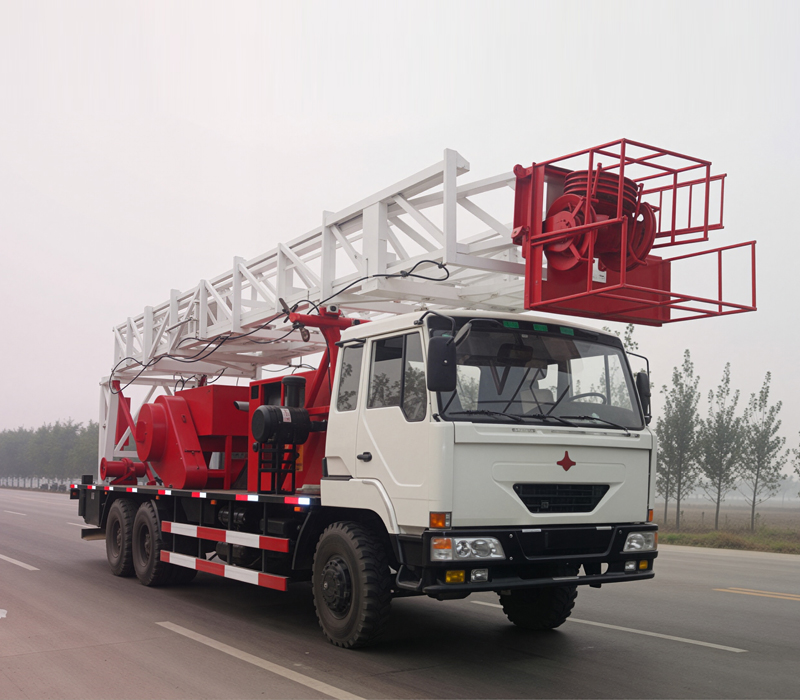
The ZYT shallow well workover package covers this duty with the 150HP, 250HP and 350HP truck-mounted workover rigs plus the well service support fleet, all matched to the same depth band and priced as one scope.
The 150HP rig works to 2,600 m, the 250HP to 3,200 m and the 350HP to 4,000 m, which covers the depth of most shallow and mature wells without paying for a deeper class.
All three travel as single self-propelled units: the 150HP is about 10.6 m long and 22.8 t, the 250HP and 350HP about 13.9 m and 31.5 t, so the rig moves between wells without crane or low-bed trailers.
Flushing, paraffin removal, swabbing, heat work and wireline jobs are covered by the support trucks in the same package, so the well is serviced in one mobilization.
The shallow package starts with the rig class. The 150HP rig carries a 585 kN maximum hook load on an 18 m mast; the 250HP XJ250 carries a 400 kN nominal and 675 kN maximum load on a 21 m or 23.5 m mast; the 350HP XJ350 carries a 650 kN nominal and 900 kN maximum load on a 23.5 m mast with a 10×8 self-propelled chassis. For tubing change and pump repair work down to about 3,000 m, the 250HP class is the usual core; the 350HP class adds reserve for heavier strings and occasional deeper interventions, and the 150HP class covers the very shallow and frequent jobs where the smallest footprint is worth more than the extra margin.
| Model | Workover depth | Max. hook load | Mast | Chassis |
| 150HP | 2,600 m | 585 kN | 18 m | 6×4 |
| 250HP XJ250 | 3,200 m | 675 kN | 21 / 23.5 m | 6×4 |
| 350HP XJ350 | 4,000 m | 900 kN | 23.5 m | 10×8 |
For the shallow depth band, the published depth figures are stated for a tubular size (2 7/8" upset tubing or 73mm tubing). Confirm the same measurement basis when comparing models, because a depth figure quoted for a lighter string is not directly comparable to one quoted for a heavier string.
The commercial argument for a truck-mounted shallow package is the move count. Each self-propelled move avoids the crane and trailer hire, the road permits where they apply, and usually a full day of rig-up and rig-down labour. Estimate the annual move count for the field, write down the per-move saving, and multiply the two: if the result reaches the price difference between a truck-mounted and a skid-mounted rig within two or three years, the chassis pays for itself. In mature fields with dozens of wells and service cycles measured in weeks, that calculation usually falls clearly on the truck-mounted side.
The 350HP XJ350 moves on a 10×8 chassis and the 450HP and larger classes on 12×8 all-terrain chassis, so confirm the axle configuration and the loaded height against the roads and bridges on the route before committing the class. If the field roads are very tight, the 150HP and 250HP units on 6×4 chassis have a smaller footprint and lighter road load.
The rig handles the hoisting, but the shallow well job is completed by the service fleet. The standard package includes the well flushing and paraffin removal truck for flow-line and tubing maintenance, the swabbing unit (with swabbing tool) for production testing and unloading, and the boiler truck for hot-oil and heat work. For wells with wireline requirements, the wireline unit is added; for larger fluid volumes, the fluid supply truck (rated 750 m3/h at 45 m head) supports the flushing and tank work; and for multi-well programmes, the mobile workshop keeps the fleet running in the field instead of returning to base for repairs.
| Unit | Duty | Typical package role |
| Well flushing & paraffin removal truck | Flow-line and tubing flushing, wax removal | Standard |
| Swabbing unit / tool | Production testing, unloading | Standard |
| Boiler truck | Hot-oil work, heat for paraffin jobs | Standard for waxy fields |
| Wireline unit | Logging, perforating support, gauges | Optional |
| Fluid supply truck | 750 m3/h water and fluid supply | Optional |
| Mobile workshop | Field repairs and maintenance | Optional, multi-well programmes |
Shallow wells still carry well-control obligations. Confirm the BOP fit against the mast clearance and the rig floor layout, and state the wellhead and casing programme in the inquiry so the supplier can confirm the substructure and the well-control fit. For the operating environment, confirm the temperature range and the dust or corrosion treatment: the rigs are configurable for desert, plateau and cold-region service, and the 350HP class in the truck-mounted line is rated for continuous duty across -20°C to +55°C with cold-start and heat-dissipation options for extreme sites.
Request the package as line items so the boundary is visible: rig, service trucks, tanks and manifolds, documentation and spares. Confirm the certification level that applies to the exact configuration, the commissioning scope and the spare-parts list for the first operating period. A package quotation from one supplier keeps the interfaces, the documentation set and the commissioning plan consistent, which is worth more in a high-move-count operation than the difference between two single-machine prices.
Send the field profile: the number of wells, the typical depth and tubing size, the service cycle and move frequency, the task list (flushing, swabbing, paraffin removal, wireline or light drilling), the road and site conditions, the quantity of packages, the destination port and the required documentation. With the field profile, the supplier can match the rig class, the service fleet and the spare and support terms as one shallow well workover package.
These answers frame the shallow-field equipment choice; final scoping depends on the field profile and the site conditions.
The 150HP, 250HP and 350HP truck-mounted workover rigs cover working depths up to about 4,000 m and hook loads to 900 kN, which matches the majority of shallow and mature field work at a lower purchase and operating cost than the deep-service classes.
Mature fields run a high well count with short service cycles, so the rig moves between wells every few days. A self-propelled truck-mounted unit rigs up and down faster and avoids crane and trailer costs on each move.
Typically a well flushing and paraffin removal truck, a swabbing unit, a boiler truck for heat work, a wireline unit and a fluid supply truck. A mobile workshop covers field repairs on multi-well programmes.
Yes, within limits. The 350HP rig drills to about 1,000 m on 4 1/2-inch drill pipe in its truck-mounted form, and the 450HP and 650HP classes extend that further, so the package can be configured for combined drilling and workover duty.