5000 m rated logging depth
The ZYT5142TCJ is rated to 5000 m on phi5.6 mm or phi8 mm cable, which sets the open-hole and production-logging envelope. The cable size is chosen against depth and sonde weight, and the depth rating follows that choice.
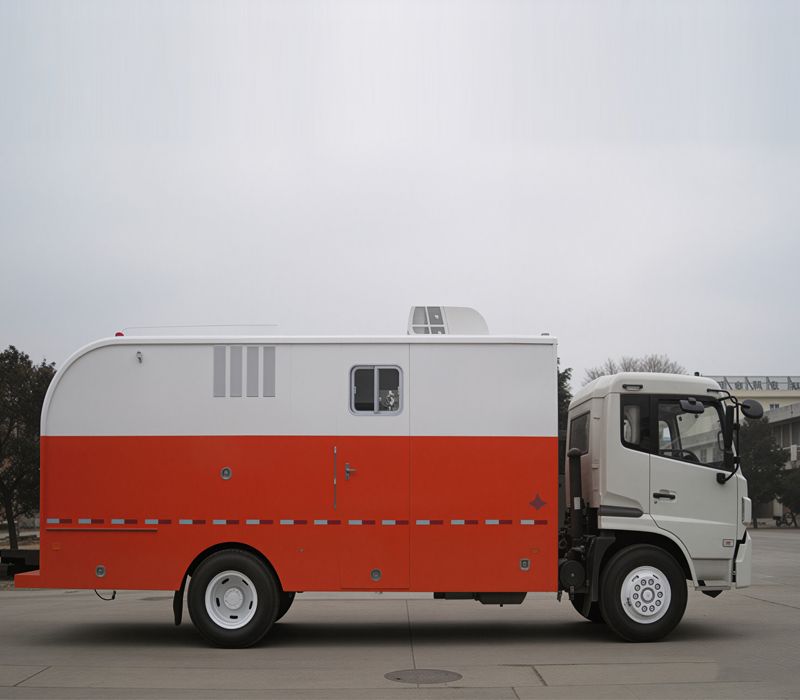
The logging truck is a measurement platform first: model ZYT5142TCJ on a DFL1160BX5 chassis, rated to log to 5000 m on phi5.6 or phi8 mm armored cable, with a winch pull of 30 or 50 kN for the two cable sizes and a hoisting window from 130 to 8000 m/h. That speed range is the tell for a logging unit, since the sonde crawls down slowly for clean curves and is pulled fast between runs, and the 20 MPa hydraulic system drives the winch rather than doing mechanical work downhole. What goes down is an instrument string measuring resistivity, porosity, temperature and pressure; what comes up is the data set for reservoir evaluation, open-hole and production logging alike. At 90 km/h road speed and an 8650x2466x3520 footprint, the whole lab drives between well sites as one load.
The ZYT5142TCJ is rated to 5000 m on phi5.6 mm or phi8 mm cable, which sets the open-hole and production-logging envelope. The cable size is chosen against depth and sonde weight, and the depth rating follows that choice.
Winch pull is 30 kN on phi5.6 mm cable and 50 kN on phi8 mm cable, sized to hold the sonde and cable at 5000 m without over-tension. The two ratings reflect the cable breakover point, not a mechanical downhole job.
Hoisting speed spans 130 to 8000 m/h: a slow crawl for clean log curves and a fast trip between runs. That wide window is what distinguishes a logging winch from a wireline workover winch.
A 20 MPa hydraulic system powers the logging winch with stepless control, giving the constant-tension feed the sonde needs. Hydraulic drive isolates the sensitive instrument string from engine-speed surges.
The truck carries the data-acquisition workstation and independent power supply in the 8650x2466x3520 body, so resistivity, porosity, temperature and pressure curves are plotted on site rather than after transport. The road-going lab is what makes one truck a complete logging crew.
Rated at 90 km/h on the DFL1160BX5 chassis, the unit moves between dispersed logging locations as a single vehicle. For a reservoir-evaluation campaign spanning several wells, that mobility cuts rig-up time to the winch-stabilization step.
| Product | Logging Truck |
|---|---|
| Product line | Inspection & Testing Equipment |
| Model | ZJ5142TCJ |
|---|---|
| Chassis model | DFL1160BX5 |
| Rated depth of logging (m) | 5000(φ5.6/φ8mm电缆cable) |
| Max hoisting pull(kN) | 30kN/50kN(φ5.6/φ8mm电缆cable) |
| Hoisting speed(m/h) | 130-8000 |
| Rated pressure of hydraulic system(MPa ) | 20 |
| Max speed(km/h) | 90 |
| overall dimension(L×W×H):mm | 8650×2466×3520 |
For a useful technical response, include the target well conditions, operating depth or pressure, expected quantity, destination and any required configuration.
Send an InquiryAvailable configurations can be matched to the equipment model, operating conditions and project requirements.
What buyers check on the logging truck: winch capacity, cable handling and logging service scope.
The Logging Truck is professional oilfield geophysical exploration equipment. It carries downhole logging instruments to collect formation physical parameters, wellbore data and reservoir dynamic information, provides accurate geological evaluation basis for oil-gas layer identification, reserve calculation and development scheme optimization, and is the core equipment for oilfield exploration and well condition evaluation.
It supports multiple mainstream logging scenarios, including open-hole reservoir logging, cased well engineering detection, production dynamic logging and auxiliary while-drilling logging. It adapts to new well evaluation, old well monitoring and geological exploration tasks of various oil and gas wells.
The equipment adopts constant-tension servo control and low-speed stable winch drive to avoid instrument jitter and data mutation. The industrial anti-interference data acquisition system filters on-site noise in real time, and the full-process automatic recording mechanism ensures the authenticity, continuity and accuracy of all logging data.
Yes. The unit is specified for field logging across climates, with the winch, drum and hydraulic system protected for dusty and cold conditions; the hoisting window of 130–8000 m/h is what controls log quality more than ambient temperature. State the operating environment and any winterising requirement in the inquiry so the climate provisions are confirmed with the quote.
Yes. The configuration is settled against the logging programme before the order: cable size (φ5.6 or φ8 mm), winch pull grade (30 or 50 kN), depth rating within the 5000 m envelope, hoisting-speed window and the instrument/acquisition package are matched to the target depth, sonde string and site climate, then written into the quotation and the factory test report.
Commercial terms are confirmed in the quotation for the exact configuration, quantity and destination.
Built to petroleum-industry API standards at the Jingzhou plant under ISO 9001:2015 quality management; the winch pull (30/50 kN) and constant-tension hold are verified on a test spool before dispatch, and the certificate scope is listed in the quotation.
Operation and maintenance manuals, chassis documentation and factory test reports are supplied; the hydraulic and electrical schematics are included for the client's service department.
Confirmed in the quotation according to configuration, quantity and destination.
Manuals, conventional spare parts and remote technical guidance are included; on-site commissioning and operator training can be arranged on request.
Payment schedule, Incoterms, port and packaging are agreed in the sales contract.
A recommended spare-parts list for the first operating period is provided with the quotation.
Explore nearby products to compare equipment scope before sending an inquiry.